Scene
That music heals the soul is something you’ve probably heard, and maybe even said yourself. But that sentence isn’t just an Instagram cliché, behind it lies a real biological and neurological basis. Many recent studies have shown that music, especially electronic music, can have a truly healing role and lead us into meditative states.
Thanks to its repetitive rhythm, electronic music creates neuronal and physiological entrainment – synchronization of our mind and body with each other, as well as with external stimuli. This process can lead us to focus, trance, meditation, regeneration, and even healing.
Neuronal entrainment – the brain in rhythm
Our brain activity constantly oscillates in frequencies, these are the so-called brain waves, measurable in hertz (Hz). They change depending on our state of consciousness:
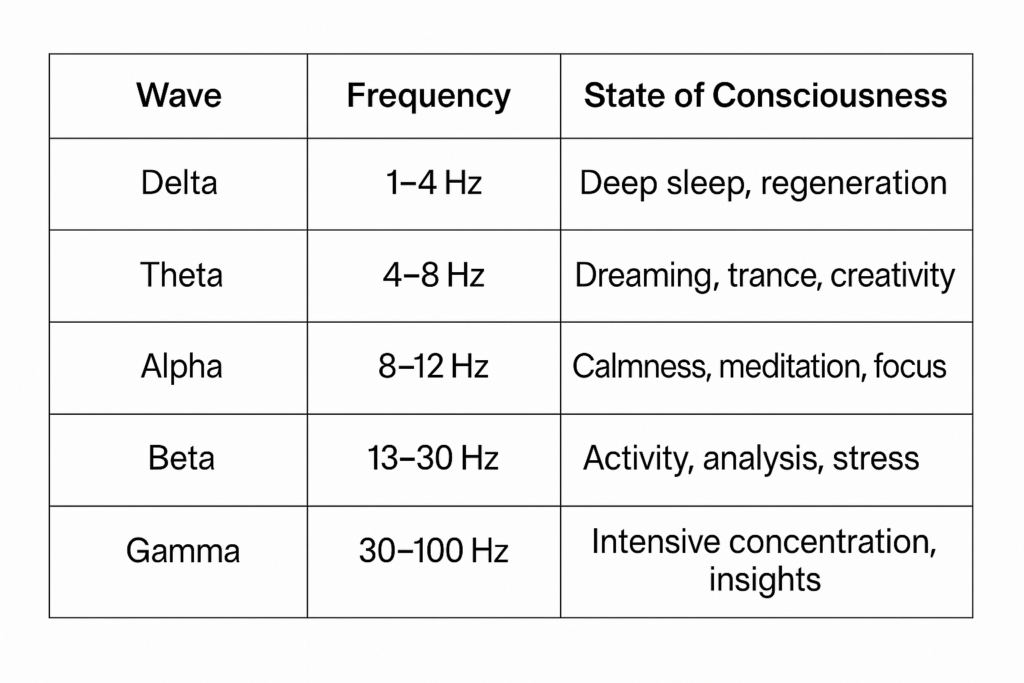
When we hear a repeating rhythm, neurons in the auditory part of the brain begin to synchronize with that frequency. That’s neuronal entrainment – the moment when the brain literally “dances” with the beat.
Electronic music has very precise and stable rhythms, so when we listen to music in the range of 120 to 130 BPM for a while (which corresponds to about 2 Hz), our brain waves begin to align with that rhythm. We shift from analytical beta waves to slower alpha and theta frequencies, which bring us into a flow state.
Repetitive beats and rhythms without sudden changes actually calm the brain. The part of the brain that constantly analyzes, plans, and overthinks slowly quiets down. Then emotions, instinct, and the body come to the surface. That’s why at some point you no longer know what time it is or where exactly you’re standing – you just feel that you are completely “here.” This is the neurophysiological description of what many call transcendence on the dancefloor.
In meditation, we reach that state through breathing and silence, while at a party – through rhythm and movement. Seemingly opposite principles, such as stillness and motion, silence and sound, actually lead us to the same outcome.
Physiological entrainment – the body in rhythm
Everything in us has its own rhythm: heartbeat, breathing, muscle tension, cellular vibration. When we listen to a steady beat, our autonomic bodily rhythms begin to align with it. In other words, the body literally takes the music as a reference for its own tempo.
Our heart naturally “listens” to the rhythms around it. When exposed to a moderate, repetitive rhythm (for example 60–130 BPM), heart rate (HR) and heart rate variability (HRV) start to synchronize with the external tempo. Slower rhythms calm us, faster ones activate us, but in a harmonious, non-stressful pattern.
During dancing, breathing also spontaneously synchronizes with the music, the body begins to “breathe in phrases,” expanding and contracting in harmony with the waves of sound. This leads to reduced cortisol (the stress hormone), better oxygenation, and the release of muscular tension through rhythmic movement. That’s why people often feel relief and reset after long dancing – it’s not a metaphor, but a real physiological reaction.
Low frequencies (that deep bass you feel in your chest) don’t just pass through the ears but through the entire body. That sound literally sets our internal rhythms in motion, calms the nervous system, and relaxes tension.
Why don’t we always feel it?
There are many scientific facts about how rhythm affects us, but the question is – why don’t we all feel it all the time? It’s no secret that among partygoers it’s popular to use stimulants to “feel the music” or enhance the experience. Behind that often lies an unconscious desire to let go – to quiet the mind, feel the body, be present.
But the paradox is that the very search for ecstasy often blocks what already naturally exists within us. As psychologist Mihaly Csikszentmihalyi described in his theory of flow, true immersion arises when the need for control disappears. When you stop “trying to feel” and simply align with the rhythm, the body and brain naturally enter synchronization.
When you stop trying to “feel” and simply let the rhythm guide you, the body and brain align on their own. Of course, it’s not always easy – we all bring our thoughts and tensions to the party. But if you see it as an opportunity to let go, the dancefloor can become a space for healing, and the DJ your therapist.
How to let the rhythm work:
Breathing – start with your breath.
With deep inhales and exhales, you bring your body from tension into presence. When you hear the beat, try to breathe in rhythm – inhale over a few bars, exhale over the next. Breathing thus becomes the bridge between you and the music.
Movement – release the need to “dance well.”
Let your body find its own pattern. When movement becomes spontaneous, the body synchronizes with the beat and activates deep physiological resonance. Neuroscience today calls this somatic regulation – a state in which the body naturally releases tension and regenerates.
Awareness – close your eyes.
Listen not only to the music but also to the space between beats. Mozart said: “The music is not in the notes, but in the silence between.” Notice where you feel the music – in your belly, chest, feet? In that listening, the brain synchronizes with rhythm, the heart with bass, and the breath with the space between.
Collective rhythm – this is why going to a party with a good crowd can be an unforgettable experience.
When several people breathe and move in the same rhythm, what psychologists call collective or group flow happens. It’s a state in which the flow of individuals who share the same goal amplifies, and the energy among them begins to move as one. On the dancefloor, listening to the same rhythm, shared breathing and pulsing occur during which the ego dissolves, leaving only the feeling of connection – energy circulating between bodies.
When you stop trying to “feel the music” and simply become the space where it happens, you become part of it, and you don’t need drugs to feel it.